
Performance · Locking & Security
Fingerprint door locks and advanced security locking, seamlessly integrated into every certified security door.
Exceptional security is never defined by the door alone. It is the combination of the door, frame, locking system and installation working together as a single engineered solution. That is why every entrance is specified with locking that matches its security rating, whether traditional mechanical multipoint locking, biometric fingerprint access, smart locking technology or keypad entry. Professionally surveyed, specified and installed by our own experienced team, ensuring the entrance performs exactly as it was designed to.
- Multi-point Three to five point engagement
- Fingerprint entry Fitted where specified
- Anti-drill cylinder Anti-pick as standard
- 40+ years In the security trade
- Across London and beyond Surveyed and installed


The locking hardware, specified with the door build, not added afterwards.
Locking specification
What locking systems do we fit on a security door?
Every steel or aluminium security door we install is supplied with a multi-point locking system as standard, with its cylinder, handle, hinge protection and dog bolts carefully specified to match the certified security rating of the door.
The locking system is engineered into the door from the outset, not added afterwards. Every cylinder, hinge protection, locking mechanism and security component is selected to work together as one complete, integrated security system.
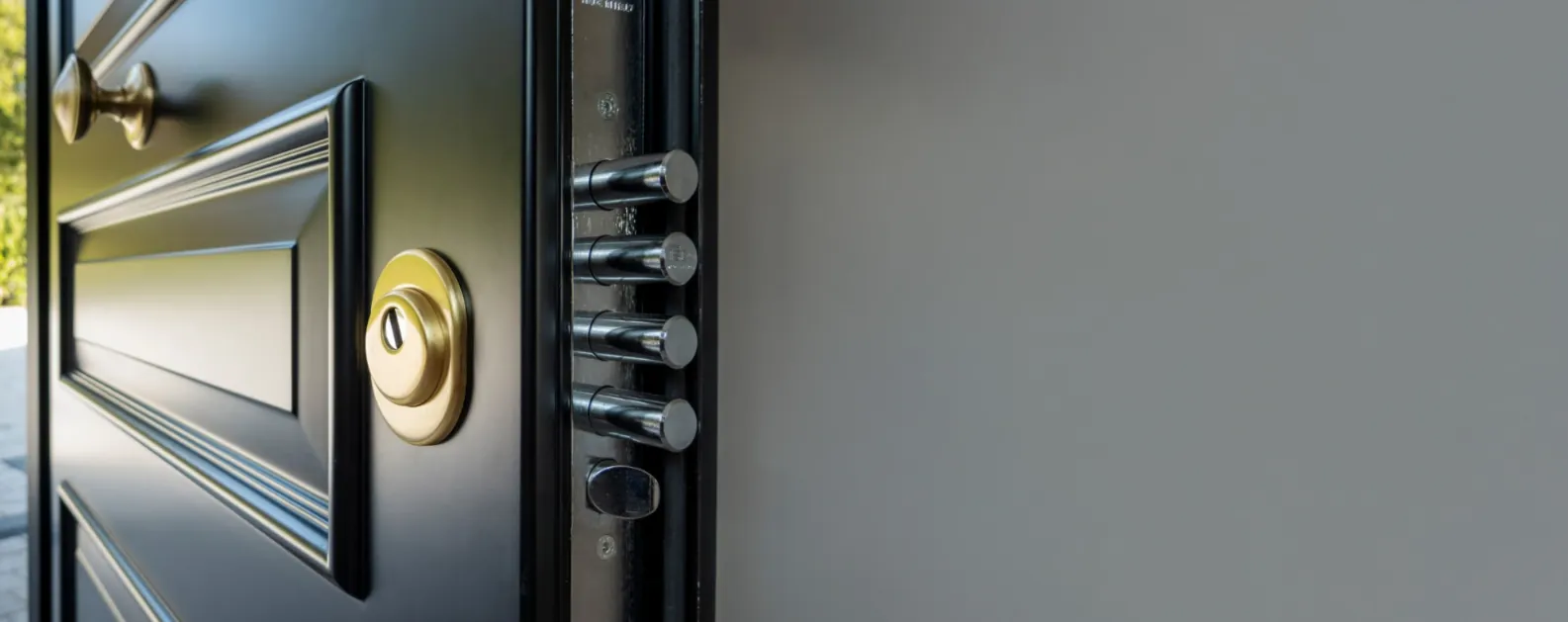
As the door closes, the multi-point locking system engages at three or five points around the frame, securing the top, hinge side, latch side and base in one smooth movement. By distributing force across the entire doorset instead of a single bolt, it delivers exceptional strength, refined operation and security that matches the certified performance of the door.
Standard specification on every steel security door
- Multi-point locking: Three or five locking points engaging the frame at the top, hinge side, latch side and base.
- Anti-drill, anti-pick cylinder: Hardened steel insert, snap-resistant housing and pick-resistant keyway.
- Concealed hinge-side dog bolts: Heavy-duty shoot bolts secure the hinge side of the door into the frame, preventing attacks on the hinges.
- Anti-jemmy threshold: Rebated steel threshold designed to resist pry bar and crowbar attacks.
- Laminated security glazing: Where glazing is specified, P5A or P6B laminated security glazing ensures the glass never becomes the weakest point.
Every locking component is matched to the construction rating of the door, ensuring the locking hardware performs to the same standard as the security doorset itself. The result is a complete entrance system engineered to deliver lasting strength, reliability and peace of mind.
Biometric entry
How does fingerprint entry work on a front door?
A fingerprint door lock replaces or supplements a key cylinder with a biometric reader: it holds your registered fingerprints and releases the multi-point lock the moment a stored print is confirmed.
Fingerprint entry combines advanced security with effortless everyday convenience, and it is not a gadget bolted on. Integrated into the door during manufacture, the biometric reader replaces or augments the cylinder in the lock furniture, wires into the door's multi-point locking mechanism and draws the same latch back that a key would, all while preserving the certified performance of the doorset. Unlike aftermarket smart locks, the reader is engineered as part of the entrance itself: the biometric reader is the entry method, not a separate product.
We fit fingerprint entry to aluminium and steel front doors wherever the hardware suits the door's locking system. The reader holds several fingerprints, so every member of the household can enjoy secure, keyless access. For complete peace of mind, a code backup is available where the reader is the primary entry method, so a power cut or a pair of wet hands never leaves you locked out.
What the installation involves:
- The reader is specified at the survey alongside the rest of the lock furniture.
- Wiring runs cleanly through the door to a power source, concealed within the door leaf.
- Registration of fingerprints happens at installation, with our fitter walking you through the process.
- A key cylinder or backup code is retained as a secondary entry method.


Multi-point locking
Multipoint locking: why it matters, and how ours works.
A multipoint locking door secures the frame at multiple points simultaneously, creating a far stronger connection between the door and frame than a traditional single-bolt lock can achieve.
A conventional front door typically relies on a single deadlock or rim lock, concentrating all resistance at one point. Under force, that single fixing bears the entire load. A multipoint locking system distributes that force instead, engaging locking points at the top, side and base of the door, while concealed hinge-side dog bolts protect the hinge edge from attack. The result is a stronger, more stable entrance that resists forced entry while operating effortlessly every day.
Our steel and aluminium security doors are engineered around the locking system from the very beginning. The multipoint mechanism is integrated into the doorset, with every locking point matched to the strength of the galvanised steel frame and security-rated construction, ensuring the entire entrance works as one engineered system rather than a collection of individual components.
Because every door is made to measure, multipoint locking comes as standard across our entire range of front doors. During your survey, we specify the locking configuration to suit the size, weight and security rating of your entrance. Whether that requires three, five or more engagement points, every door is engineered specifically for your home, never built to a generic specification.
Entry options
Access control and keypad entry options.
Keypad entry and access control systems can be fitted to any of our security doors where keyless entry suits the property, or where several users need to come and go without a key.
A keypad door lock replaces the key cylinder with a secure PIN code, making everyday access simple for households where keys are forever going missing, properties with a steady stream of regular visitors, or anyone who would rather not hand out keys at all. Like fingerprint entry, the keypad drives the same high security multi-point locking mechanism, integrated into the door during manufacture rather than added afterwards.
Access control doors use a credential reader, whether keypad, fob, fingerprint or card, wired to an electronic release. Once reserved for commercial buildings, they are now increasingly chosen for luxury homes, wherever the flexibility of managed, controlled access is worth having.
Entry options we can specify at survey:
- Key only: Standard anti-pick, anti-drill cylinder with a mechanical key.
- Keypad: PIN code entry, with a mechanical key backup.
- Fingerprint reader: Biometric entry for named users, with backup code or key.
- Fob or card reader: Access control for properties where credential management matters.
- Combined: Fingerprint plus keypad, or reader plus key, where two-factor entry is appropriate.
Every option is specified at the free survey, where we weigh the property, the number of users and the level of risk before recommending the right configuration for you.


Door security systems
Is a high security door lock enough on its own?
A high security lock in a weak door is not security at all: the door gives way long before the lock does. That is why we treat the locking system and the door construction as a single specification, not two separate purchases.
A lock is rated for its own resistance. A door is rated for the resistance of the whole assembly: the leaf, the frame, the hinges, the threshold and the locking mechanism working as one. When an independent test body rates a door construction under a standard such as LPS 1175 or PAS 24, it tests the complete doorset, lock included. Fit a high security lock to a door that has never been tested as an assembly and you learn how the lock performs on a bench, not how the doorset holds up under a real forced entry.
This is the difference between fitting a lock and engineering an entrance, and it is what separates a locksmith from a door specialist. A locksmith fits a lock to whatever door happens to be there. We specify the locking system and the doorset as one, so the lock is matched to a door built and tested to resist forced entry as a whole. Our steel doors are built and tested to SR3, and our aluminium doors to RC3 to RC4, with every cylinder, hinge protection and locking mechanism specified to match the certified performance of the door. With 40+ years in the security trade behind every recommendation, we know where weak points tend to appear, and we specify to close them.
If you already have a good door and simply want the lock upgraded, you will get an honest assessment at the free survey. If what you have is worth keeping, we will tell you. If the door itself is the weak point, we will say so.


Good to know
Frequently asked questions about security door locking.
What locking system do your security doors use?
Our security doors use a multi-point locking system as standard, driven by an anti-pick, anti-drill cylinder. When you lift the handle and turn the key, hardened bolts engage the frame at several points at once, top, side and base, so the whole door is held in place rather than just the centre. The exact lock and cylinder are specified to match the security rating of your door.
What is a multipoint locking system?
A multi-point locking system engages the door frame at three or more points at the same time when the door is closed and locked. A standard lock holds at a single point; multi-point locking spreads the load across the top, sides and base of the frame, which makes the door far harder to force or lever open. Every steel and aluminium door we supply is fitted with it as standard.
Can I have fingerprint entry?
Yes. A fingerprint reader can be fitted to your steel or aluminium door, storing your registered prints and releasing the lock at a touch, with no key to carry or lose. It is specified and wired as part of the door installation, not added afterwards, so the reader, the power and a backup entry method are all planned in advance. We confirm compatibility with your chosen lock at the survey.
Can I unlock my door with my smartphone?
Yes. A smart lock lets you unlock the door from your phone, so you can let people in or secure the door without a physical key. It is fitted as part of the doorset, with a mechanical key retained as a backup so a flat phone or battery never leaves you locked out. We specify the smart lock and its power supply at the survey.
Can I have keypad access?
Yes. A coded keypad can be fitted to your door, so entry is by PIN rather than a key, which is useful for households, guests or trades. The code can be changed whenever you like, and a mechanical key backup is retained alongside it. We specify the keypad on a door built to resist forced entry, so the entry method is never the weak point.
Can I use key fobs with my security door?
Yes. Key fob or card entry can be fitted as a form of access control, releasing the lock when a registered fob is presented to a reader. Fobs are easy to issue and to cancel if one is lost, which makes them a practical choice for a busy household. The reader is wired and tested as part of the installation, with a mechanical backup retained.
Can your doors integrate with my alarm system?
In many cases, yes. The access control and electric release hardware we fit can be specified to work alongside a range of alarm systems, so the door and the alarm operate together where the two are compatible. Because every alarm setup is different, we assess yours at the survey and confirm exactly what can be linked before we quote.
Can your doors connect to my smart home?
Often, yes. Smart locks and access control can link to app control and, where compatible, to common smart-home platforms, so the door can sit alongside the rest of your connected home. Compatibility depends on the system you use, so we check it at the survey and specify hardware that works with your setup rather than promising a connection we have not confirmed.
Are your security doors independently tested?
Yes. The doors we supply are built to independently tested standards: LPS 1175 for steel, BS EN 1627 resistance classes for aluminium and pivot, and PAS 24 across the range. Independent testing means an accredited laboratory has attacked the doorset with defined tools for a set time and recorded how it held, so the rating is a test result rather than a claim. We can provide the relevant documentation for your specification.
What is the difference between mechanical and smart locking systems?
A mechanical locking system works entirely by key and handle, driving the multi-point bolts with no power required, which makes it simple and completely reliable. A smart locking system adds electronic entry, such as a fingerprint reader, keypad or phone app, on top of that mechanism, for convenience and control over who has access. We always retain a mechanical key backup behind any smart system, so you keep the reliability of the one and the convenience of the other.
Book a free survey
The right lock starts with the right door.
We specify the locking system as part of the door, all of it settled at the free survey. A single visit covers the door, the frame, the entry method and the security rating, with a written quote to follow.